Google starts rolling out its Play Protect feature for the Play Store app


Google starts rolling out its Play Protect feature for the Play Store app


Google starts rolling out its Play Protect feature for the Play Store app

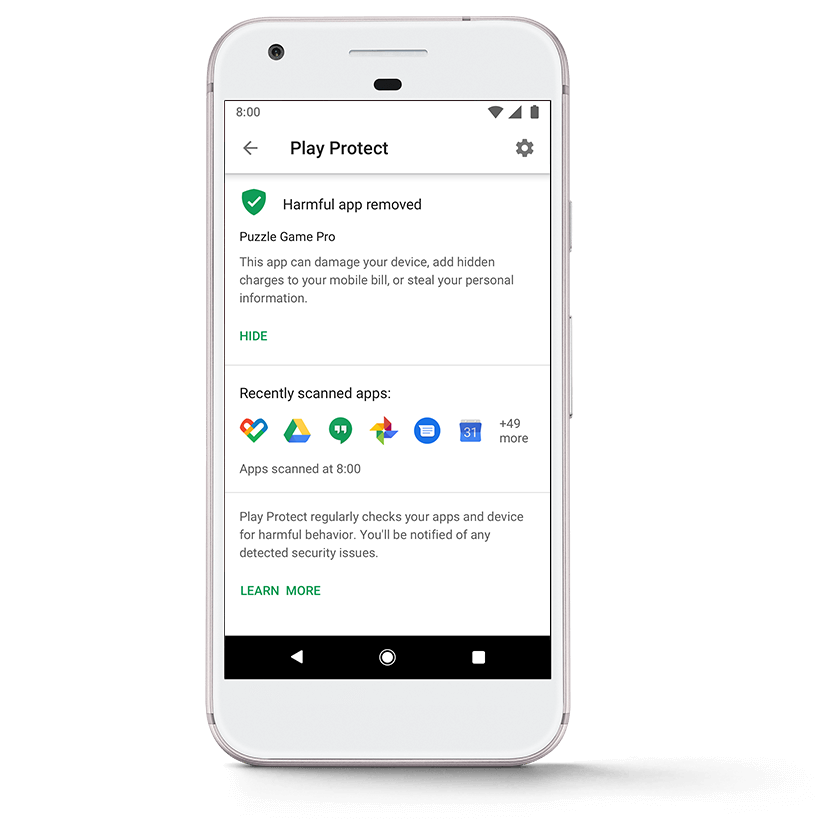
Google has unified and rebranded its Android security tech – meet Google Play Protect. It scans apps in the Play Store before you download them to make sure they follow the rules.
But Play Protect also watches apps as they run on phones and uses machine learning to detect unexpected behavior – when that occurs, you get a notification and the app gets the boot. Google boasts that it scans 50 billion apps a day.
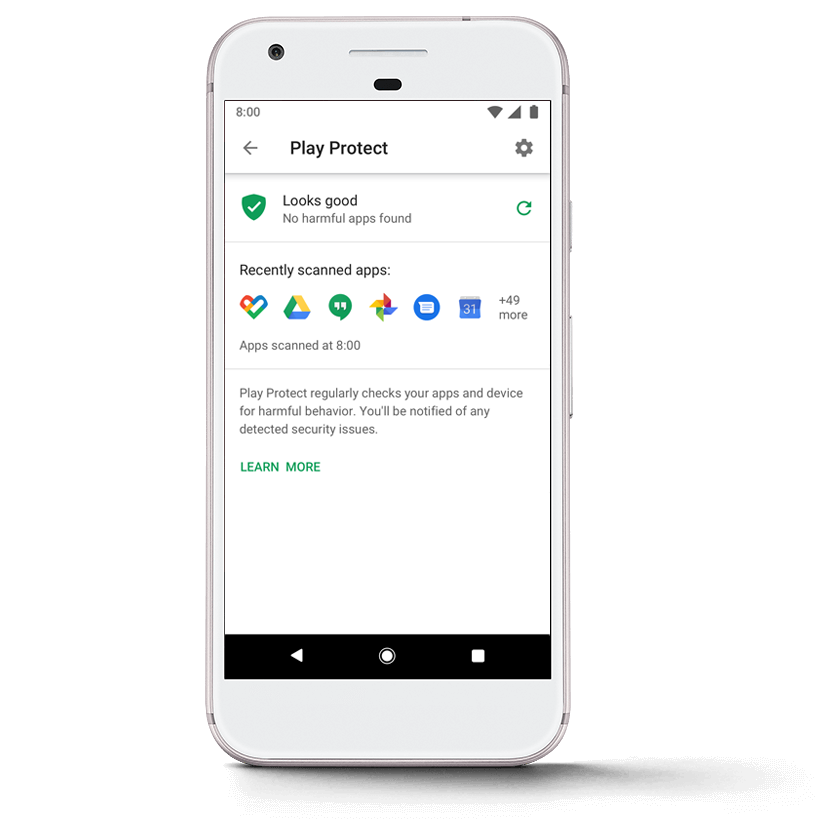
  
Google Play Protect guards against malicious apps

You can go into Google Play and you’ll see a banner in the Updates screen telling you everything is fine. And there are extra settings in the Menu. Note that this feature is still rolling out and may not be on your device yet.
Chrome features Safe Browsing that will warn you before you venture into a potentially dangerous site (you’ve probably seen this in desktop Chrome as well)
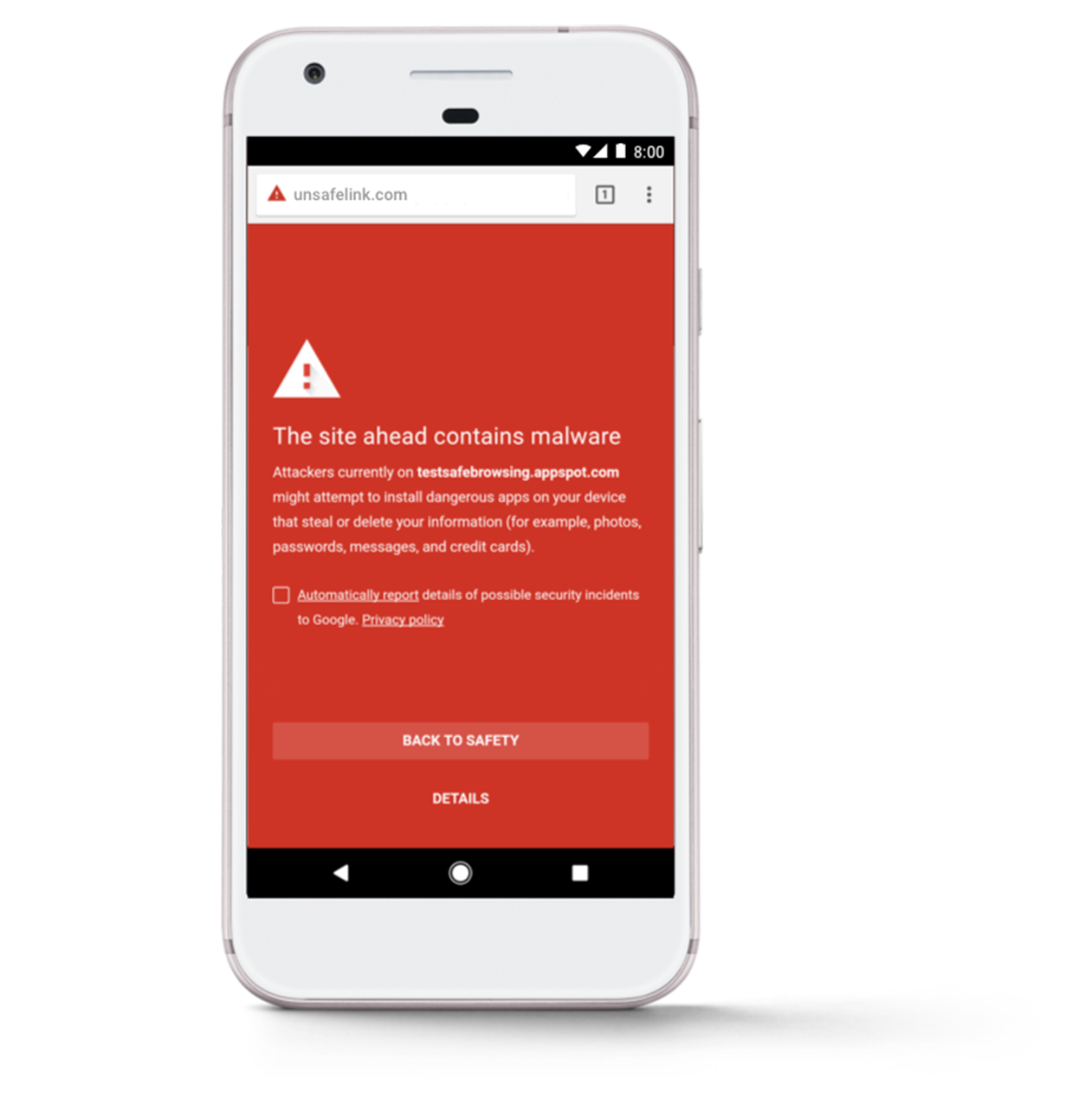
 
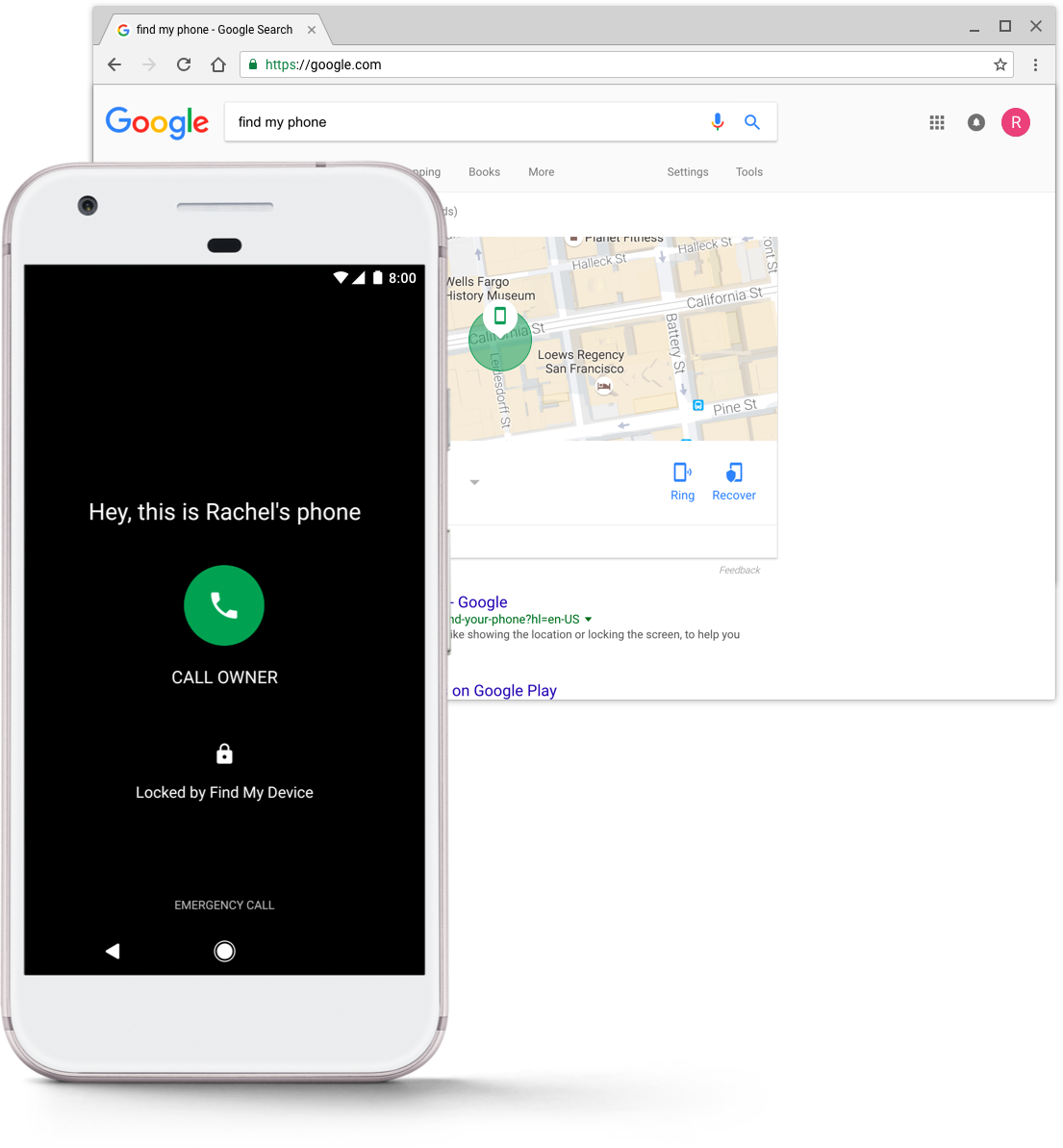
Safe browsing • Find my phone

Find My Device is now under the Play Protect banner. It locates your phone, allows you to lock it and put a note on its screen and even lets you call it through a desktop browser.

Source

Samsung's 10-Year Plan Starts With 128TB QLC SSD, 960 Successor

Samsung's 10-Year Plan Starts With 128TB QLC SSD, 960 Successor


Samsung disclosed more details than ever before about V-NAND. The company has formulated the path to 8th generation V-NAND and has ideas on how to take the technology to 10 generations. A number of new manufacturing techniques must be applied, but a detailed discussion of those is beyond the scope of this particular article.
Samsung says it can achieve its targets with its first generation QLC (4-bits per cell) V-NAND technology.
The first product pre-announcement (it doesn't have a product number yet) is a 128TB SAS SSD using QLC technology with a 1TB die size. The company plans to go beyond 16 die per package using chip stacking technology that will yield 32 die per package, a flash industry record.

QLC NAND will be slower than TLC on a per-die level, but with that amount of parallelization, the performance could be much better than expected. Samsung didn't share many details on what to expect from QLC, other than massive capacity.

Just two years ago, the company announced the first flash-based product to deliver more capacity than hard disk drives. A year later, the 16TB capacity mark doubled to 32TB. The jump to 128TB shows just how fast flash technology is moving.

Last year, Samsung announced a competing technology to Intel's Optane but didn't give us too many details to write about. We speculated the technology used some form of optimized SLC (single-level cell) flash and, according to the latest from the company, we were correct. The Z-SSD shipping today to select customers carries the SZ985 name, but this first-generation product with 800GB of usable capacity will soon be replaced by a second-gen model. The next leap for Z-SSD using Z-NAND technology will add a bit to each cell, MLC Z-NAND, and increase overall density. Just don't expect either Z-SSD to appear on Newegg anytime soon.

Samsung 970 and 980 NVMe SSD Coming Soon


We saved the best for last. Samsung hasn't announced or even muttered the words "980" or "970" NVMe SSD, but we found a reference to both on the UNH InterOperability Laboratory list. We usually fly to Samsung's South Korean office in September to learn about new products coming to market, but this year we may know about the successor to the 960 EVO and Pro in advance.

With Samsung using 64-layer 3-bit per cell V-NAND for many next-generation consumer products, the EVO / Pro naming structure may change. The UNHIOL lists two new NVMe SSDs under the 97x and 98x product names. For context, The 960 series appeared as "96x" last year.
We don't think Samsung will have QLC flash ready by the end of the year to use in products, but the company has surprised us before with aggressive launch cycles. We expect both of these products to ship with 64-layer 3-bit per cell V-NAND in late 2017 in limited volumes, with increased availability in early 2018.

How Hyperloop Works?

How Hyperloop Works?

A hyperloop is a proposed mode of passenger and/or freight transportation, first named as such in an open-source vactrain design released by a joint team from Tesla and SpaceX. Drawing heavily from Robert Goddard's vactrain, a hyperloop comprises a sealed tube or system of tubes through which a pod may travel free of air resistance or friction conveying people or objects at optimal [clarification needed] speed and acceleration.


                                                    Video Source : Hyperloop

But what is a hyperloop?

In Musk’s words, a hyperloop is a system to “build a  tube over or under the ground that contains a special environment.” Cars  would basically be propelled in this tube. One example could be a huge  sort of pneumatic tube where high-speed fans would compress and push the  air — although the friction implications make Musk skeptical that it  would work. Another option is having a vacuum in the tube and using  electromagnetic suspension instead. Musk acknowledges it is hard to  maintain a vacuum (one small leak in hundreds of miles of tubing, and  the system shuts down), but there are pumping solutions to overcome  this. He favors the second solution.


Video Source: Hyperloop


How does it work?


Hyperloop has four key features.

1) The passenger capsules aren't propelled by air pressure like in vacuum tubes, but by two electromagnetic motors. It is aimed to travel at a top speed of 760 miles per hour.

2) The tube tracks do have a vacuum, but not completely free of air. Instead, they have low pressure air inside of them.


Most things moving through air tubes will end up compressing the air in the front thus, providing a cushion of air that slows the object down. But the Hyperloop will feature a compressor fan in the front of the capsule. The compressor fan can redirect air to the back of the capsule, but mostly air will be sent to the air bearings.


3) Air bearings are ski like paddles that levitate the capsules above the surface of the tube to reduce friction.

4) The tube track is designed to be immune to weather and earthquakes. They are also designed to be self-powering and unobstructed. The pillars that rise the tube above the ground have a small foot-print that can sway in the case of an earthquake. Each of the tube sections can move around flexibly of the train ships because there isn't a constant track that capsules rely on.


With these innovations and completely automated departure system, Elon Musk's dreams of the Hyperloop being the fastest, safest and the most convenient form of travel in the world.

Source: Tech Insider

Apple Plans to Release LTE Support Watch


Apple Plans to Release a Cellular-Capable Watch

Image Source: Vogel/AP/REX/Shutterstock


·         Intel is said to supply modem that works with cell networks
·         Apple plans to begin selling new smartwatch by end of year


 (Source: Bloomberg)

Apple Inc. is planning to release a version of its smartwatch later this year that can connect directly to cellular networks, a move designed to reduce the device’s reliance on the iPhone, people familiar with the matter said.

Currently, Apple requires its smartwatch to be connected wirelessly to an iPhone to stream music, download directions in maps, and send messages while on the go. Equipped with LTE chips, at least some new Apple Watch models, planned for release by the end of the year, will be able to conduct many tasks without an iPhone in range, the people said. For example, a user would be able to download new songs and use apps and leave their smartphone at home.

Intel Corp. will supply the LTE modems for the new Watch, according to another person familiar with the situation. That’s a big win for the chipmaker, which has been trying for years to get its components into more Apple mobile devices. Qualcomm Inc. has been the main modem supplier for iPhones and other Apple mobile gadgets, but the two companies are embroiled in a bitter legal dispute. Apple added Intel as a modem supplier for some iPhones last year.

It may be launch in september

Source

Google's next Pixel might look a lot like the old one

Google's next Pixel might look a lot like the old one


Google is likely going to reveal a new Pixel and Pixel XL in the coming months. We've already seen an image of the rumored Pixel XL, codenamed Taimen, and now, we're getting a peek at the smaller Pixel follow-up, codenamed Walleye.

Evan Blass at VentureBeat tweeted this image today:

Instead, Google seems to have directed manufacturing partner HTC to make only iterative design changes to the smaller of its own-branded phones. Unlike last year, when HTC made both the Pixel and the Pixel XL, this time around LG has been tasked with producing the larger device.

While HTC has yet to introduce a handset with significantly reduced “forehead and chin,” LG’s G6 and Q6 both include so-called FullVision displays, whose 18:9 screens cover the vast majority of the products’ faces. Samsung is also heavily invested in bezel minimization this year, with its Galaxy S8 and Note8 flagships, along with Apple and what is shaping up to be an iconic iPhone.

HTC is, however, bringing its expertise to bear in two other aspects of both 2017 Pixels: front-facing stereo speakers, which it made popular with its BoomSound branding, and squeeze-sensitive frames, embodied in the Edge Sense feature found on this year’s U11 flagship.


There is one area in which Google is closely following the lead of other phone makers with respect to flagship feature sets, but it involves the omission, rather than the inclusion, of a once-standard component. VentureBeat can confidently report that, like Apple, HTC, and Lenovo, Google has opted to do away with 3.5-millimeter headphone jacks on its offerings this year.


Source

iPhone 8 display assembly spotted, no Touch ID in sight

iPhone 8 display assembly spotted, no Touch ID in sight

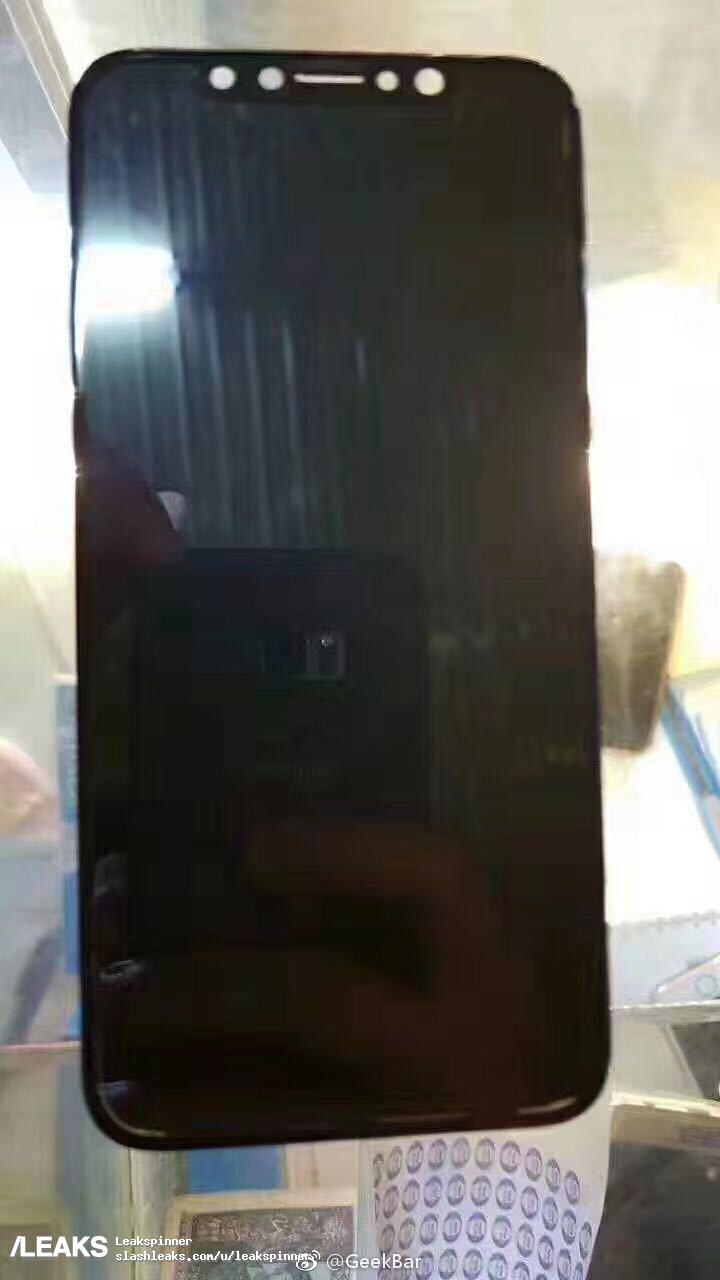
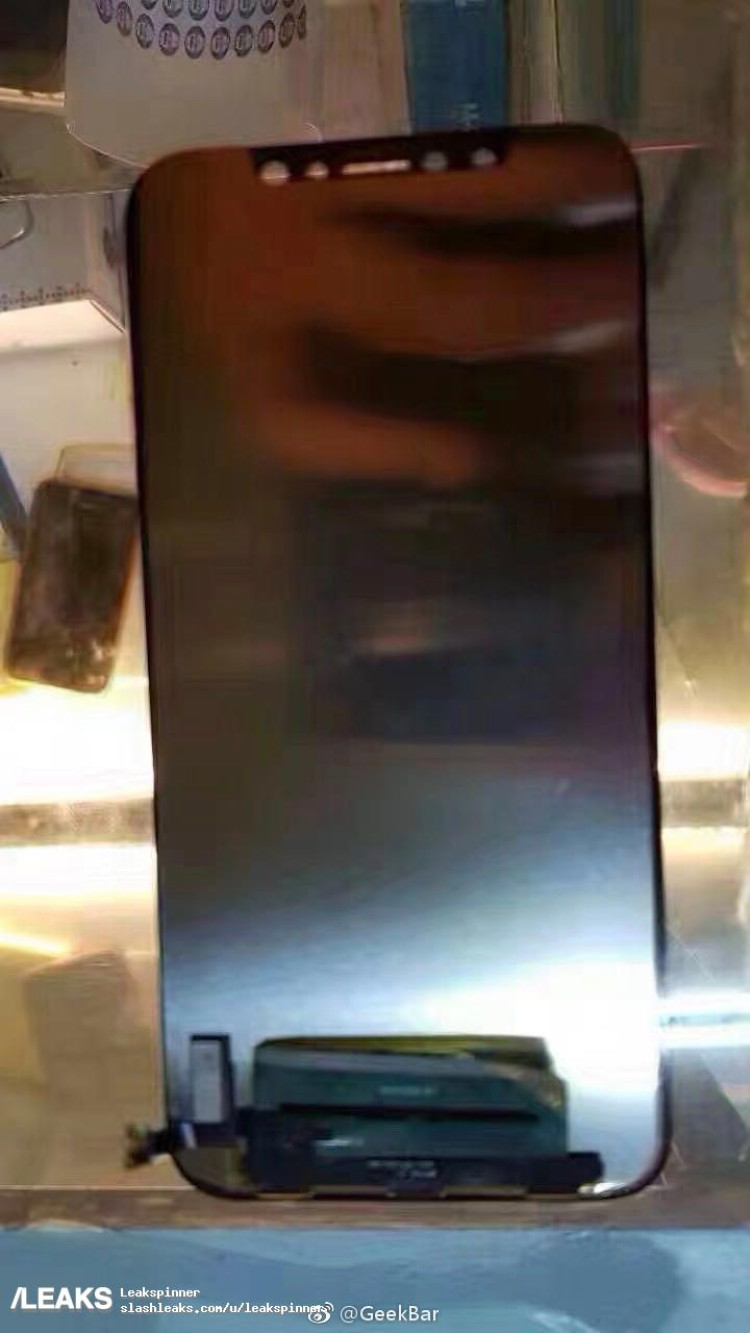
Iphone 8 display assembly leaks out


Last we heard, the highly anticipated anniversary iPhone 8 is still on track for a September announcement and a very limited November-December initial release. That hopeful report was quickly followed up by reputable industry insider tips that production of the Apple crown jewel has indeed started, meaning part leaks are inbound as well!


There is also no sign of a Touch ID sensor, at least not in the traditional iPhone round home button fashion. This, of course, leads us back into the ongoing fingerprint reader debate. Here are the options so far: First there is the popular theory that a large side-mounted power key will hold the sensor, much like on some Sony Xperia phones. A less likely scenario is having the reader embedded in the glass back of the iPhone 8. We've already seen alleged photos of it and those don't really suggest such a setup. An under-display option, while still technically possible is widely dismissed by expert, at least for this iPhone generation.


iPhone 8 renders based on schematics by case maker Nodus

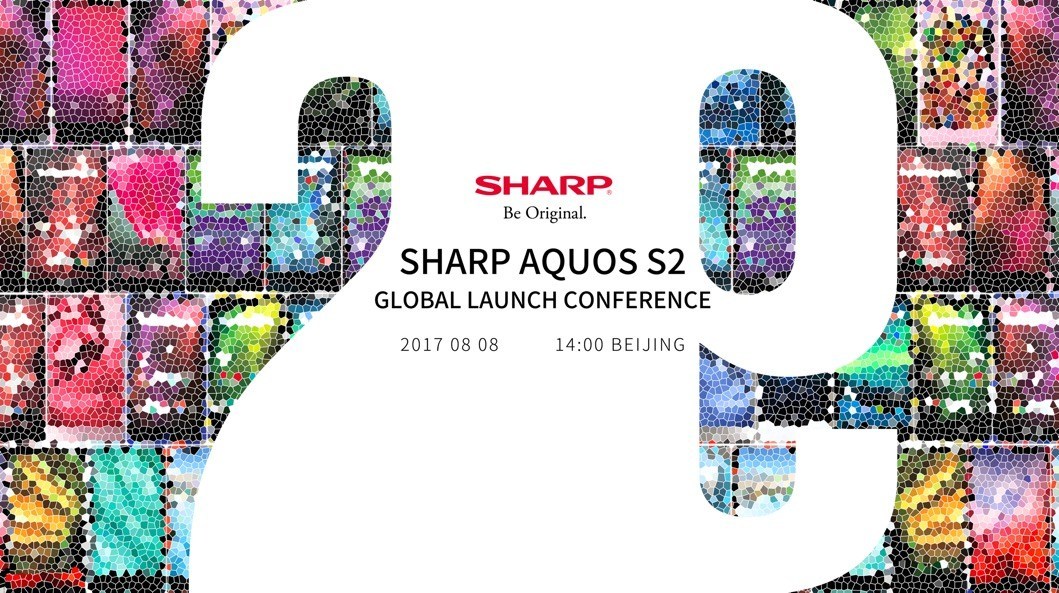
Sharp to launch a 'full screen' smartphone in china, to go on sale on 14 August

Sharp to launch a 'full screen' smartphone in china, to go on sale on 14 August


The latest SHARP AQUOS S2 applies FFD (Free Form Display) technology to dig small holes precisely in the screen for the front camera and receiver, so it offers great user experiences for selfies and excellent audio quality. Its screen-to-body ratio is as high as 84.95%, which makes the 5.5-inch display screen feel like a 5-inch screen body while being held.

"The core of full screen design is to break through the technology limit, achieve the double sense of holding and visual comfort, and provide the ultimate experience for users," said Dr. Luo Zhongsheng, CEO of SHARP/InFocus Mobile.

SHARP has intensively delved into investigations of full screen technologies. It was the first manufacturer to come up with the world's first full-screen phone, the EDGEST-302SH. The smartphone has a screen-to-body ratio of 80.5% and ultra slim bezels from three sides.

The company then introduced SHARP AQUOS CRYSTAL product series into the market which applied bone conduction technology and adopted edge reflection approach to accomplish the border-less infinite visual effect in 2014. SHARP has released 28 full screen phones since 2013, which are well received by the market.

Introducing a 100% bezel less screen phone is the ultimate target for all manufacturers. However, there are several obstacles blocking the development of full screen smartphone, for example, the front camera, front fingerprint identification, receiver. SHARP AQUOS S2 with three bezels is currently the largest full screen smartphone right now.

Basic Specs :

•             Display: 5.5 inch
•             RAM: 4 GB/ 6 GB
•             CPU: 2.2 GHz Octa core
•             Rear Camera: 12 MP
•             Phone Memory: 64 GB/ 128 GB
•             OS: Android OS v7.1

LGQ6 India launch on August on 10; will be an Amazon Exclusive

LGQ6 India launch on August on 10 ,will be an Amazon Exclusive


the LG Q6 will be released in the company's home market, South Korea before entering other countries in Asia, Europe, the U.S. and Middle East. Now, there some information regarding the Indian availability of the LG Q6. The company has taken to Twitter to announce that the LG Q6 will be launched in India on August 10 as an Amazon exclusive. The teaser put up by LG India's Twitter handle shows that the smartphone will be priced at Rs. 1_,990.

Basic Specification of LG Q5:


  • Chipset: Qualcomm Snapdragon™ 435 Mobile Platform
  • Display: 13.97cm(5.5) 18:9 FHD+ FullVision Display (2160 x 1080 / 442ppi)
  • Memory: 3GB RAM / 32GB ROM
  • Camera: Rear 13MP Standard Angle / 5MP (100°)Wide Angle Front
  • Security: Face recognition/ KnockCode
  • OTG Support: Yes, OTG(on the go)
  • Battery: 3,000mAh (Embedded)
  • Operating system: Android 7.1.1 Nougat
  • Size: 142.5 x 69.3 x 8.1mm
  • Weight: 149g
  • Network: LTE / 3G / 2G
  • Connectivity: Wi-Fi 802.11 b, g, n / Bluetooth 4.2 / USB Type-B 2.0
  • Colors: Astro Black / Ice Platinum / Terra Gold
  • SIM: Dual SIM Slot & Dedicated micro SD
  • Other: Google Assistant / Square Camera / Military standard 810G certification
  • Whats in the box: Handset,Adapter,data cable,Earphone and Quick start guide.


OxygenOS 4.5.7 OTA for OnePlus 5

OxygenOS 4.5.7 OTA for OnePlus 5


OnePlus has put a hold on the rollout of the OxygenOS 4.5.7 for the OnePlus 5.

Here are some of the highlights of this build:

New additions:
  • Introducing the all new OnePlus Slate font
  • Added EIS for 4K video recording
Updates:
  • Updated Android security patch level to 1st July 2017
  • Updated to latest GMS package
Optimizations:
  • Wi-Fi connectivity improvements
  • Standby battery enhancements
Bug Fixes:
  • Fixed occasional sound leaks in the speakers when using earphones
  • Fixed camera shutter sound bug in silent mode for Indian region
  • Fixed missing sound channels when recording videos
The company will be directly pushing 4.5.8 update to those on 4.5.7 and older versions of the OS that will include all changes in 4.5.7 and fix for the stuttering issue.

Xiaomi Mi 6 and Redmi Note 4X to get MIUI 9 on August 11

Xiaomi Mi 6 and Redmi Note 4X to get MIUI 9 on August 11

MIUI 9 was announced along with the Xiaomi Mi 5X last week and its official rollout is starting in a week. The first two phones to get it are the Xiaomi Mi 6 and the Xiaomi Redmi Note 4Xand they will only have to wait until August 11.


Two weeks after the first dispatch, on August 25, 12 other phones will get MIUI 9. They are the Mi Mix, the Mi Note 2, the Mi 5, the Mi 5s, the Mi 5s Plus, the Mi 5c, the Mi Max and its newer sibling the Mi Max 2, the Mi 4s, the Mi 4c and the Redmi 4X.
There will be a third wave of updates come September. That will include some entry level devices from a few years back - Redmi 2A and Redmi 1/1S.
The new MIUI 9 brings Smart app launcher, Image search, and Smart assistant. It also has a particular CPU acceleration mode and better haptic feedback.
The update is currently available only in China, but Xiaomi promised to deliver the Global version soon.
Thanks for the tip!
Source (in Chinese) | Via

HUAWEI MediaPad T3 7 Specification


HUAWEI MediaPad T3 7


SIZE:


COLOUR
  • Space Gray, Moonlight Silver


DISPLAY 

  • Size: 7.0 inches
  • Type: IPS display
  • Resolution: 1024 x 600 (HD)
  • Contrast: 800:1

CPU
  • MTK MT8127, quad-core A7, 4 x 1.3 GHz, 512 KB L2

OPERATION SYSTEM
  • Android M (Marshmallow)

MEMORY
  • ROM: 8 GB / 16 GB
  • RAM: 1 GB / 2 GB

NETWORK
  • Standards: IEEE 802.11 a/b/g/n@2.4GHz&5GHz
  • Function: Supports Wi-Fi Direct.

GPS
  • Support GPS

SENSORS
  • Gravity sensor

CAMERA
  • Rear camera: 2 MP and fixed focus
  • Front camera: 2 MP and fixed focus

AUDIO
  • *.mp3, *.mid, *.amr, *.3gp, *.aac, *.wav, *.ogg, *.flac, and *.m4a

VIDEO
  • *.3gp, *.mp4, *.webm, *.mkv, .ts, .mov, .avi, and .flv

EMOTION UI
  • EMUI 4.1

BATTERY
  • 3100 mAh (typical)

IN THE BOX
  • Charger*1,Quick start guide*1,Warranty card*1

Huawei BG2-U01 (MediaPad T3 7) 3g-tablet gets TENAA certified

Huawei BG2-U01 (MediaPad T3 7)

3g-tablet gets TENAA certified

Looks like Huawei is all set to launch a new variant of the MediaPad T3 7.0 tablet (that was launched back in May this year). Carrying a model number of BG2-U01, the tablet is powered by a quad-core 1.3GHz CPU, and sports a 7-inch display of 1024 × 600 pixel resolution.


RAM is 2GB, while storage is 16GB. The device features a 2MP rear and 2MP front camera.
Measuring 187.6 x 103.7 x 8.6mm and weighing in at 275g.
the tablet runs Android 7.0 Nougat and packs in a 4,000mAh battery.
It's worth mentioning that unlike the existing MediaPad T3 7.0,
the BG2-U01 offers cellular connectivity - it is compatible with GSM and WCDMA networks.
Aside from TENAA, the tablet has also received WiFi certification from the WiFi alliance.
That listing clearly states the product name as 'MediaPad T3 7'.


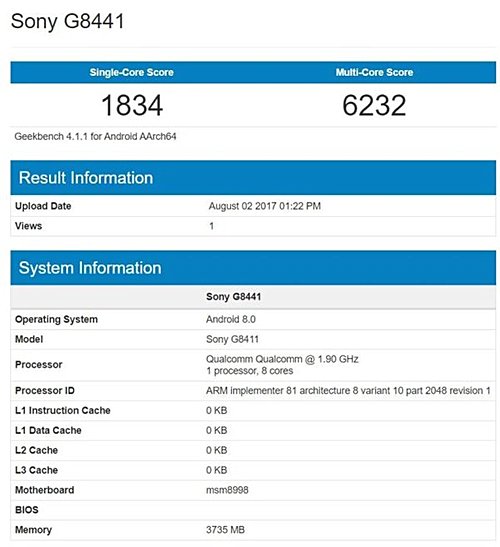
Sony G8441 spotted in benchmark listings, could well be Xperia Z1 Compact


A new Sony smartphone has surfaced on Geekbench. Listed as Sony G8441, the device is powered by Snapdragon 835 SoC, packs in 4GB RAM, and runs Android 8.0.


The handset was also spotted in a AnTuTu listing a few weeks ago, revealing 32GB storage, 720p display resolution, and 8MP/8MP camera combo.
Now, the Xperia XZ1 also features Snapdragon 835 SoC and 4GB RAM, but has a Full HD resolution (display size is 5.2-inch). Moreover, it is identified as G8341, so the G8441 is likely a different device.
Digging deeper, a rumor from May this year said the Xperia XZ1 Compact will also be powered by Snapdragon 835 SoC and come with 4GB RAM. Just that it'll have a smaller display: 4.6-inch. So it's highly likely that the G8441 is the Xperia XZ1 Compact. The device is said to pack in a 2,800mAh battery.
Via

AdSense

Google starts rolling out its Play Protect feature for the Play Store app

Google starts rolling out its Play Protect feature for the Play Store app Google starts rolling out its Play Protect feature fo...

Popular Posts